Just-in-Time Teaching (JiTT)


Learning technologies should be designed to increase, and not to reduce, the amount of personal contact between students and faculty on intellectual issues.
(Study Group on the Conditions of Excellence in American Higher Education, 1984)


Just-in-Time Teaching (JiTT)


Alexander W. Astin
"What matters in college?:four critical years revisited"
Jossey-Bass Publishers,1993


The three critical factors:


Just-in-Time Teaching (JiTT)

Learning Styles

The Felder-Silverman Model


Learners classified as:
sensingintuitive
visualverbal
inductivedeductive
activereflective
sequentialglobal


Just-in-Time Teaching (JiTT)

Traditionally Science and Engineering Instruction Favors


sensingintuitive
visualverbal
inductivedeductive
activereflective
sequentialglobal


Teaching to All Types

Borrowed from Felder

  • Connect theory to phenomena that relate to it (sensing, inductive, global)

  • Balance conceptual information (intuitive) with concrete information (sensing)

  • Use sketches, diagrams, etc (visual) in addition to oral and written (verbal)

  • Supplement symbolic examples (intuitive) with numerical examples (sensing)

  • Illustrate magnitudes with physical analogies and demonstrations (sensing, global)

  • Occasionally give experimental observations before presenting general principles (inductive)

  • Provide time to think about the material (reflective) and for active participation (active)

  • Encourage or mandate cooperation (fits all styles and makes employers happy)

  • Supplement the logical development of topics (sequential) with connections to other material , other courses, daily experience (global)


Checklist of Skills (presumed present)

Borrowed from Arons

  • Arithmetical Reasoning (ratios)

  • Ability to Paraphrase a Paragraph of Text

  • Awareness of Gaps of Knowledge or Information

  • Understanding the Need for Operational Definitions

  • Translating Words into Written Symbols and Written Symbols into Words

  • Discrimination between Observation and Inference

  • Drawing Inferences from Data and Evidence, Including Correlational Reasoning

  • Ability to Discriminate Between Inductive and Deductive Reasoning

  • Performing Qualitative, Phenomenological Reasoning or Thinking

  • Checking Inferences, Conclusions, or Results


Just-in-Time Teaching (JiTT)

Instructional Objectives


  • Encourage frequent, short study sessions

  • Connect textbook to the real world

  • Encourage the development of
    • critical thinking
    • estimation skills
    • the ability to deal with ill-defined problems

  • Develop cooperative work habits and communication skills


Just-in-Time Teaching (JiTT)


Just-in-Time Teaching (JiTT)

WarmUps and Puzzles


  • Concepts - Vocabulary - Notation
  • Modeling - Connecting concepts and equations
  • Visualization - Graphing
  • Estimating - Getting a feel for magnitudes
  • Relating physics to "common sense"
  • Applying Mathematical Relations - the scope of applicability


  • Concepts - Vocabulary

    During aerobic exercising, people often suffer injuries to knees and other joints due to HIGH ACCELERATIONS. When do these high accelerations occur?
    1. These injuries occur when a runner increases his/her speed and is running faster than 'normal.' People need to slowly build up to a quicker speed instead of diving right into it.

    2. These high accelerations occur when you start and stop the excersices because the initial and final speed is zero. While exercising the speed of bending joints is pretty much constant; therefore, the acceleration is zero.

    3. Injuries to the knee occur when the foot makes contact with the floor. The acceleration swiftly goes to zero and then back up again in the opposite direction that it was just going. This causes great stress on the knee and is when most of the injuries occur.

    4. The high accelerations will occur when high velocity is achieved over a short period of time like in a leg kick. The injury probably occurs when the motion comes to an almost instant stop and the acceleration is a large negative value.


    FCI - The Force Concept Inventory


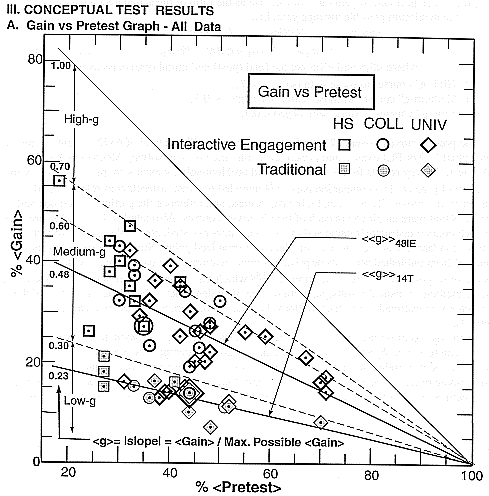
    The Hake Factor


    Just-in-Time Teaching (JiTT)


    What Does it Take in The Classroom?

    "use of IE methods in all components of a course and tight integration of all those components, careful attention to motivational factors and the provision of grade incentives for taking IE activities seriously,

    "augmentation of the teaching staff by undergraduate/graduate students,

    "apprenticeship education of instructors new to IE methods,"

    "early recognition and positive intervention for potential low-gain students," and

    "more personal attention to students by means of human-mediated computer instruction in some areas" .

    [Hake, Am. J. Phys. 66 (1), 1998, 64-74.]


    Just-in-Time Teaching (JiTT)

    "Managing THE QUALITY OF CLASSROOM DISCOURSE is the single most important factor in teaching with interactive engagement methods. This factor accounts for wide differences in class FCI score among teachers using the same curriculum materials and purportedly the same teaching methods. Effective discourse management requires careful planning and preparation as well as skill and experience."

    (HESTENES, AJP, JUNE 1998)


    Just-in-Time Teaching (JiTT)

    AN EXAMPLE FULLBLOWN JITT WEBSITE

    STREAMLINED WEB PAGE


    Just-in-Time Teaching (JiTT)

    TECHNOLOGY ISSUES


      Small Class (N < 15)
      • Email (Each student submission is an email message to you)

      Medium sized Class (N < ~100)
      • Student submissions written to files on a server

      Large Class (N > 100)
      • Student submissions sorted and processed via a database


    Just-in-Time Teaching (JiTT)

    TEMPLATES/RESOURCES TO USE (See Workshop Resources!)

      Student submissions emailed to you
      • Simple WarmUp/Quiz Template

      Student submissions stored in files written to a server
      • Document the student sees
      • Document the instructor accesses to "retrieve" student submissions
      • Script file that "lives" on the server (saves, retrieves, clears submissions)

      Student submissions handled commercially
      • WebAssign
      • Blackboard.com