SPACE TRAVEL
The MGS Mission
The Mars Global Surveyor mission, undertaken by NASA this past Thursday, is a perfect illustration of the physics you have been studying these past weeks. Space missions combine all the most recent advances in physics and technology: mechanics, materials sciences, electronics, computing, optics, and more.
 The MGS probe will leave the (blue) Earth orbit and move along the (yellow) transfer orbit until it reaches the (red) martian orbit next fall. All this time the probe is orbiting the Sun.
Click on the orbit transfer picture on the left to see a larger image of the orbit transfer with the relevant physics data.
 1. What would be the speed of the MGS probe if it were to stay in the same orbit as the Earth (the blue orbit in the picture?) Note the position of Mars as the probe starts on its journey towards it. How does this transfer differ from the exercise in
last Friday's lab? 1. What would be the speed of the MGS probe if it were to stay in the same orbit as the Earth (the blue orbit in the picture?) Note the position of Mars as the probe starts on its journey towards it. How does this transfer differ from the exercise in
last Friday's lab?
 Once the probe reaches its destination orbit it will be shifted into an orbit around Mars (the "capture orbit" drawn in yellow.) This is the MOI (Mars Orbit Insertion) phase of the mission.
Click on the MOI picture on the right to access the larger MOI picture with the relevant physics data. (Compare this with this week's WarmUp.)
Once the probe reaches its destination orbit it will be shifted into an orbit around Mars (the "capture orbit" drawn in yellow.) This is the MOI (Mars Orbit Insertion) phase of the mission.
Click on the MOI picture on the right to access the larger MOI picture with the relevant physics data. (Compare this with this week's WarmUp.)
2. What will be the acceleration of the probe during the MOI? Why does this probe have to be slowed down as it reaches the higher orbit altitude whereas the GOP satellite in
Friday's lab had to be sped up?
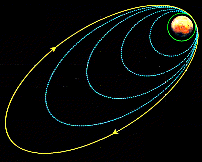 The orbiter probe is now in a highly elliptical orbit. During the next 100 days the probe will gradually shift to the "mapping orbit" from which it will perform the scientific observations. The slowdown will occur as the probe passes through upper martian atmosphere.
At the point the probe will be in a nearly
circular orbit
at 378 km above the surface of Mars.
3. What will be the speed of the martian probe in the "mapping orbit"?
Further study links:
1.  2.
3.
4.
2.
3.
4.
|