 The formulation of the laws of physics by
Isaac Newton
in terms of mathematical relations and the subsequent application of these laws to celestial mechanics led to the development of calculus .
The formulation of the laws of physics by
Isaac Newton
in terms of mathematical relations and the subsequent application of these laws to celestial mechanics led to the development of calculus .
The Egyptians developed early geometry to deal with the flooding of the Nile river which required yearly recalculations and remarkings of the land areas.
The formulation of the laws of physics by
Isaac Newton
in terms of mathematical relations and the subsequent application of these laws to celestial mechanics led to the development of calculus .
The newly acquired understanding of physical phenomena spawned the engineering efforts of the industrial revolution.
These led to the development of the mathematics of differential equations.
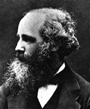
The synthesis of physics of electricity and magnetism by James Clark Maxwell gave birth to the mathematics of vector calculus. The new mathematics revealed the connection between electricity and magnetism and light and led to the discovery of electromagnetic waves. The engineering applications of these ideas gave us modern radio and TV.
 The new understanding of the connection between electricity, magnetism and light gave birth to quantum physics. Quantum physics generated a host of new mathematical ideas, among them functional analysis and group theory . A substantial part of the new quantum mathematics was generated by John Von Neumann who is also credited to be the father of the modern computer.
This physics-mathematics-engineering-physics cycle is alive and well today and it continues to chase the frontier of our understanding of nature.