"What is
Physics Good For?"
"What is
Physics Good For?"

Photocopiers
 Physics is good for developing
(and understanding) new technologies that allow
people to do things they could not do before. One
technology that we take for granted is the ability
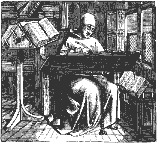
to make a good copy of a document. 100 years ago,
this was impossible. The only way to make a copy of
a document was to pay a scribe to rewrite. If the
document included a drawing, then you needed an
artist as well. The ability to make photocopies is
as important an innovation as the invention of the
printing press by Johannes Gutenburg in the mid
fifteenth century. Physics is good for developing
(and understanding) new technologies that allow
people to do things they could not do before. One
technology that we take for granted is the ability
to make a good copy of a document. 100 years ago,
this was impossible. The only way to make a copy of
a document was to pay a scribe to rewrite. If the
document included a drawing, then you needed an
artist as well. The ability to make photocopies is
as important an innovation as the invention of the
printing press by Johannes Gutenburg in the mid
fifteenth century.
Try to imagine what the following actions would
cost, in time and money, if you could not make
copies for a nickel.
- Prove that you already paid your phone
bill.
- Give 20 people a map to your house.
- Provide 50 students with a calendar of
subjects and assignments in a college
course.
- Inform all the employees of a large
corporation about a change in business
policy.
There can be little doubt, the ability to make
"photocopies" of important documents has made
expensive communications cheap, and impossible
communications possible. So, what does go on inside
the copier? There are two key steps that involve
distributing charge on an insulating surface. As
you have read in the book, an insulator is a
material that can hold electric charges in
place. In particular, charge can be placed onto
paper in a complicated pattern, including the
shapes of letters or pictures. Since paper is an
insulator, the charge will stay where it is put.
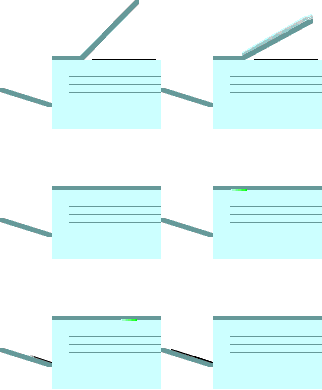
Here are the basic steps in the photocopying
process.
- A surface called the "platen" is uniformly
coated with charge. That is, it holds a uniform
"surface charge density."
-
An image of the document to be copied is shined
on the platen. Wherever the light is bright,
the surface charge drains away (the platen is
"photoconductive" is becomes a conductor when
light shines on it).
This leaves a pattern of charge on the
platen just like the pattern of light and dark
areas on the document.
- Next, "toner" is swept over the platen. The
toner is composed of tiny ink particles. The
electric field of the platen induces a charge on
the toner particles, thus attracting them to the
charged areas.
- The paper is given a surface charge and
placed against the platen.
- The toner adheres to the paper, and is fused
on at high tmeperature.
The man behind this technology is an amazing
story in his own right. Chester F. Carlson was born
in Seattle Washington in 1906. His father, a
barber, had severe arthritis, and Chester became
the primary breadwinner in his family by the age of
14. However, Carlson did manage to put himself
through college. He started out at a junior
college, then transfered to the California Institue
of Technology. He graduated with a B.S. in Physics
in 1930. The depression was in full swing, and
after applying to 82 companies Carlson had zero job
offers. He eventually got hired by Bell Labs in New
Jersey, but he was laid off soon thereafter. He got
a job with the P. R. Mallory (of battery fame) in
the patents department. The story goes that Carlson
was frustrated by the time and expense of making
duplicate copies of patent applications. He began
working to find a way to circumvent this process,
and the result, ultimately, was the photocopying
process. But the road was long. More on this story
can be found in the links at the end of this
page.
A brief history of photocopying
- 1906 Chester F. Carlson is born. Also, the
Haloid Company is founded in Rochester, N.Y.
- 1958 The Haloid Company changes its name to
Haloid Xerox, Inc.
- 1959 The first plain paper office copier is
announced, the Xerox 914.
- 1961 Haloid Xerox changes its name to Xerox
corporation, and is listed on the New York Stock
Exchange.
- 1968 Death of Chester Carlson
- 1976 The last Xerox 914 is sold.
- 1988 2 millionth XEROX copier produced
You can get a lot more information about this
subject on the internet. You can search on your own,
or try the links below.
1.  2.
3.
4.
2.
3.
4.
This site is made
possible by funding from the National Science
Foundation (DUE-9981111).
©2010
A. Gavrin, all rights
reserved.
|